

National Programme for Prevention and Control of Deafness (NPPCD)
The National Programme for Prevention and Control of Deafness (NPPCD) aims to reduce the burden of preventable hearing loss through early detection, timely treatment, and strengthening institutional capacity for ear and hearing care services. As per the Global Burden of Disease (GBD) Study 2023, the prevalence of hearing loss in India is 18.68%, while Tamil Nadu records a higher prevalence of 23.04%, indicating a greater burden of hearing loss in the State compared to the National average.Key components of NPPCD
The National Programme for Prevention and Control of Deafness (NPPCD) is being implemented in Tamil Nadu through a comprehensive approach focusing on early detection, capacity building, infrastructure strengthening, awareness generation, and inter-programme convergence. Regular screening activities are conducted at various levels of healthcare facilities, with special emphasis on newborns, school children, and other high-risk groups. The programme also supports training of healthcare personnel, strengthening of ENT and audiology services, public awareness activities, and integration with initiatives such as RBSK and School Health Programmes to ensure timely identification and management of hearing impairment.Tamil Nadu is the second State to introduce a Universal Neonatal Deafness Screening Program to provide Universal care for deafness management. .
To address neonatal hearing loss, plans are underway to establish soundproof rooms equipped with OAE/BERA equipment in 64 CEMONC centres with a high volume of deliveries..
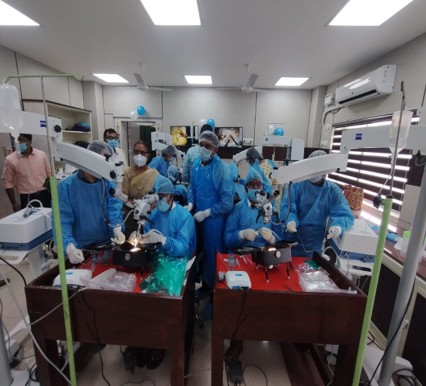
The state has also inaugurated the state-of-the-art facility for temporal bone dissection training at the State Apex Centre for NPPCD in Rajiv Gandhi Government General Hospital. The three-days training is being conducted in batches every month since August 2025. In each batch, 4 ENT Surgeons are trained on the following aspects:
- Temporal Bone cadaver Dissection demonstration and hands on training
- Live Ear Surgery observation at ENT OT
- Hands-on training on the use of OAE & BERA equipment in Audiology Department
The state is further planning to strengthen the efforts in reducing noise-induced hearing loss in the coming years, by strengthening the screening and awareness in the area of noise-induced hearing loss. The state has also advocated for the first time in India, Noise Induced Hearing Loss Policy which may be launched in the upcoming days.
In the year 2025-26, a total of 1,83,540 individuals were screened for deafness under the programme, of whom 5,893 have been provided with Hearing aids and 7,127 with Rehabilitation & follow-up services.