

About TAEI
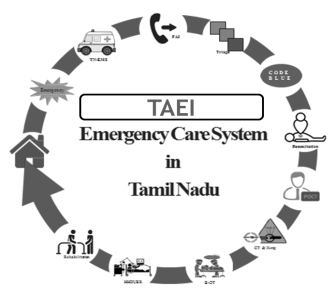
Apart from introducing state-of-the-art protocols, TAEI has ensured a major transformation of the Government healthcare delivery system. Tamil Nadu converted the traditional casualty departments into fully equipped Emergency Departments (ED), meeting the standards of the National Medical Commission (NMC) for starting postgraduate courses in MD – Emergency Medicine, a pioneering initiative in India.
Key Concepts of TAEI
TAEI introduced structured emergency care workflows by dividing patient care into clearly defined stages with specific time norms, standardized protocols, operational guidelines, checklists, and record systems to ensure efficient emergency response.
Priority-based patient assessment and treatment.
Advance notification for emergency preparedness.
Standardized clinical procedures for emergency care.
Rapid diagnostics through POCT and E-FAST.
Emergency Department Model
Emergency Departments are established by reorganizing existing casualty areas with the following facilities:
- Emergency Room (ER)
- Hybrid High Dependency Unit (HHDU)
- Emergency Operation Theatre
- CT Scan / MRI facilities
- Mobile X-Ray units
- Counselling and rehabilitation rooms
- Resuscitation bays
- Red, Yellow and Green triage zones
- TAEI Nurse Coordinators in all shifts
- Pain Management protocols
- eMLC (Electronic Medico-Legal Case management)
TAEI Coverage in Tamil Nadu
132
42
37
53
Trauma Care Initiative
Road Traffic Injuries remain a major concern in Tamil Nadu, with approximately 1400–1450 fatal accidents per month and around 40–45 deaths per day.
To address this issue, the Hon’ble Chief Minister launched the life-saving scheme Nammai Kaakkum 48 (NK-48) to provide immediate emergency medical treatment and reduce unexpected out-of-pocket expenditure for accident victims.
780
269
511
Doctors, nurses and emergency staff are regularly trained in primary resuscitation and basic trauma care to stabilize patients before referring them to higher medical centres when required.