Introduction
Health Management Information Systems (HMIS) play a critical role in strengthening the healthcare delivery system by improving data management, decision-making, and operational efficiency. HMIS refers to a comprehensive data management solution designed to collect, process, and disseminate health-related information to healthcare providers, policymakers, and administrators. It provides an integrated platform for tracking patient information, resource allocation, health outcomes, and infrastructure management, ultimately aiming to enhance healthcare services and improve patient care.
Tamil Nadu stands as one of the leading states in India when it comes to the implementation of the Health Management Information System (HMIS). The state embarked on its digital healthcare journey in 2007, introducing HMIS as a tool to streamline healthcare management and improve service delivery. Over the years, HMIS has been rolled out across various levels of the healthcare system, ensuring comprehensive coverage.
Today, the system is operational in all Primary Health Centres (PHCs), Sub-District Hospitals (SDHs), District Headquarters Hospitals (DHQHs), and Medical College Hospitals (MCHs) across the state. This wide-scale implementation has enabled real-time data collection, efficient resource management, and better monitoring of healthcare services. By integrating digital solutions into its healthcare infrastructure, Tamil Nadu has significantly enhanced its ability to track patient records, manage hospital inventories, and improve overall public health outcomes. This pioneering effort in digital health showcases Tamil Nadu’s commitment to leveraging technology for advancing healthcare.
Objectives
- Streamline Data Collection and Management: HMIS facilitates the efficient collection, storage, and management of patient records, clinical information, and health outcomes in a digitized format, reducing manual errors and delays.
- Improve Decision-Making: Real-time access to comprehensive data enables healthcare administrators, clinicians, and government authorities to make informed decisions based on accurate and up-to-date information.
- Enhance Patient Care: By integrating patient histories, treatment plans, and diagnostic reports into a single system, HMIS improves the quality of care, reduces redundancy, and enhances continuity of care.
- Resource Allocation and Planning: HMIS helps healthcare institutions track and manage their infrastructure, human resources, inventory, and logistics efficiently, allowing for optimized resource allocation and planning.
- Monitoring and Evaluation: The system supports performance monitoring, allowing for the evaluation of health programs and services. It provides insights into disease trends, public health priorities, and the overall effectiveness of healthcare interventions.
Key Features of HMIS
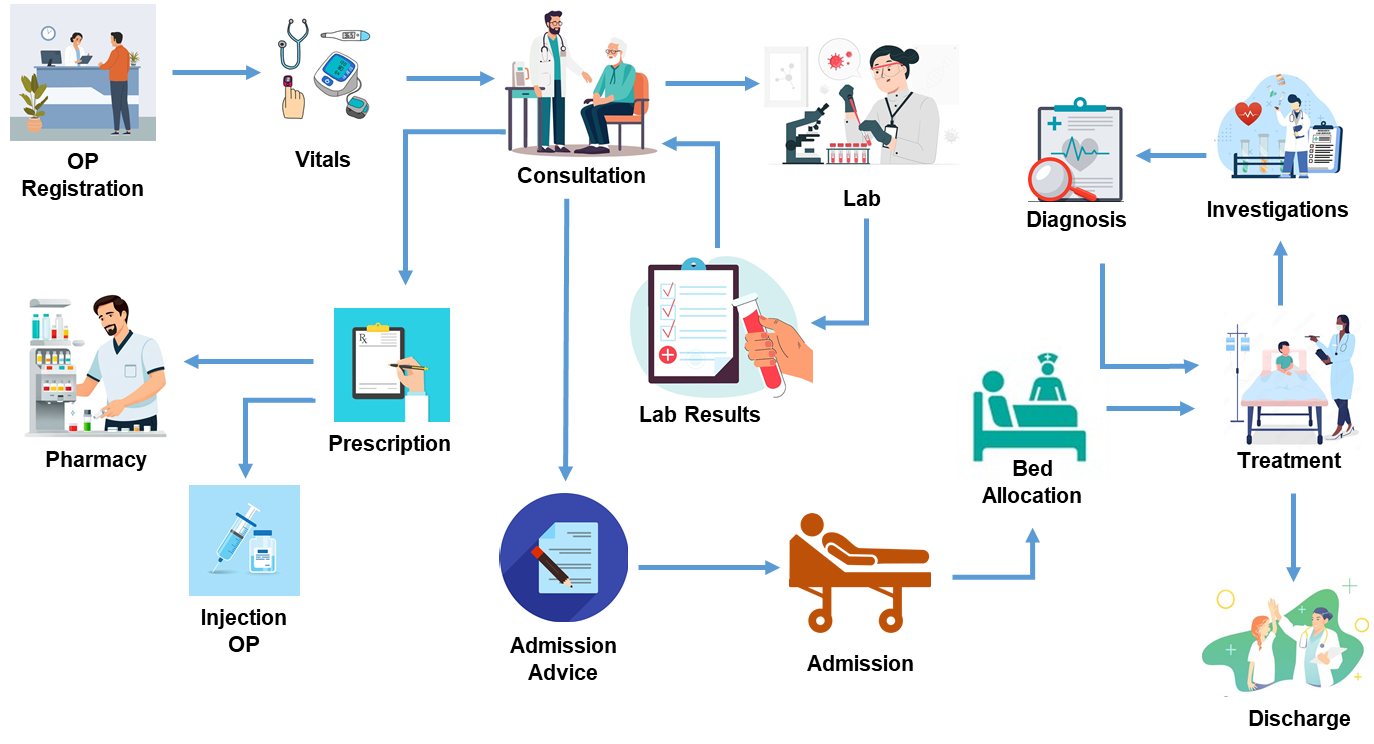
- Patient Registration and Record Management: Facilitates the registration of patients, stores their medical history, and tracks their interactions with healthcare facilities.
- Clinical Information System: Stores diagnostic data, treatment records, prescriptions, and lab results, enabling quick and seamless access to critical patient information.
- Inventory and Logistics Management: Helps track and manage medical supplies, equipment, and infrastructure across healthcare facilities, ensuring availability and timely procurement.
- Human Resource Management: Monitors staffing levels, staff performance, and workforce distribution across different health facilities.
- Financial and Funding Management: Allows tracking of funding sources, budget allocations, and expenditures related to healthcare services and programs.
- Reporting and Analytics: Provides customizable reports and dashboards for tracking performance metrics, healthcare outcomes, and resource utilization at various levels of the healthcare system.
Transition to HMIS 3.0
Tamil Nadu is now transitioning to the latest version of the Health Management Information System (HMIS) – HMIS 3.0 – as part of its ongoing commitment to improving healthcare services through technology. Building on the success of earlier versions, HMIS 3.0 brings enhanced features designed to further streamline healthcare processes, improve data accuracy, and ensure seamless integration across all healthcare facilities, from Primary Health Centres (PHCs) to Medical College Hospitals (MCHs).
The upgraded system offers improved user interfaces, advanced analytics, and enhanced reporting capabilities, allowing healthcare professionals to access real-time patient data more efficiently. This transition marks a significant step forward in the state’s digital healthcare journey, enabling better decision-making, faster service delivery, and improved patient care outcomes.
With HMIS 3.0, Tamil Nadu is further cementing its position as a leader in healthcare innovation, ensuring that its health infrastructure is future-ready and capable of meeting the growing demands of its population.
HMIS 3.0 represents a significant upgrade to the existing HMIS framework, offering enhanced features, scalability, and integration capabilities. It is designed to address the evolving needs of healthcare facilities while ensuring integration compatibility with other health IT applications.
Key advancements in HMIS 3.0 include:
- Improved User Interface: A more intuitive and user-friendly interface to simplify data entry and access.
- Enhanced Security: Strengthened data encryption and access controls to protect patient information and comply with privacy regulations.
- Interoperability: Seamless integration with other health systems, such as electronic medical records (EMRs) and national health databases.
- Mobile Access: Mobile-friendly features enabling healthcare workers to access the system remotely, improving service delivery in rural and underserved areas. Enabling patients to access the medical records through a mobile app.
Benefits of HMIS 3.0
- Improved Patient Care and Safety: With real-time access to patient data and clinical histories, healthcare providers can make more accurate diagnoses and treatment decisions.
- Operational Efficiency: Automated processes reduce the time spent on administrative tasks, allowing healthcare workers to focus more on patient care.
- Enhanced Public Health Monitoring: The system provides valuable insights into disease patterns and health trends, enabling faster responses to public health crises.
- Cost-Effectiveness: The digitization of records and automation of workflows reduce the costs associated with paper-based systems, manual labor, and redundant tasks.